



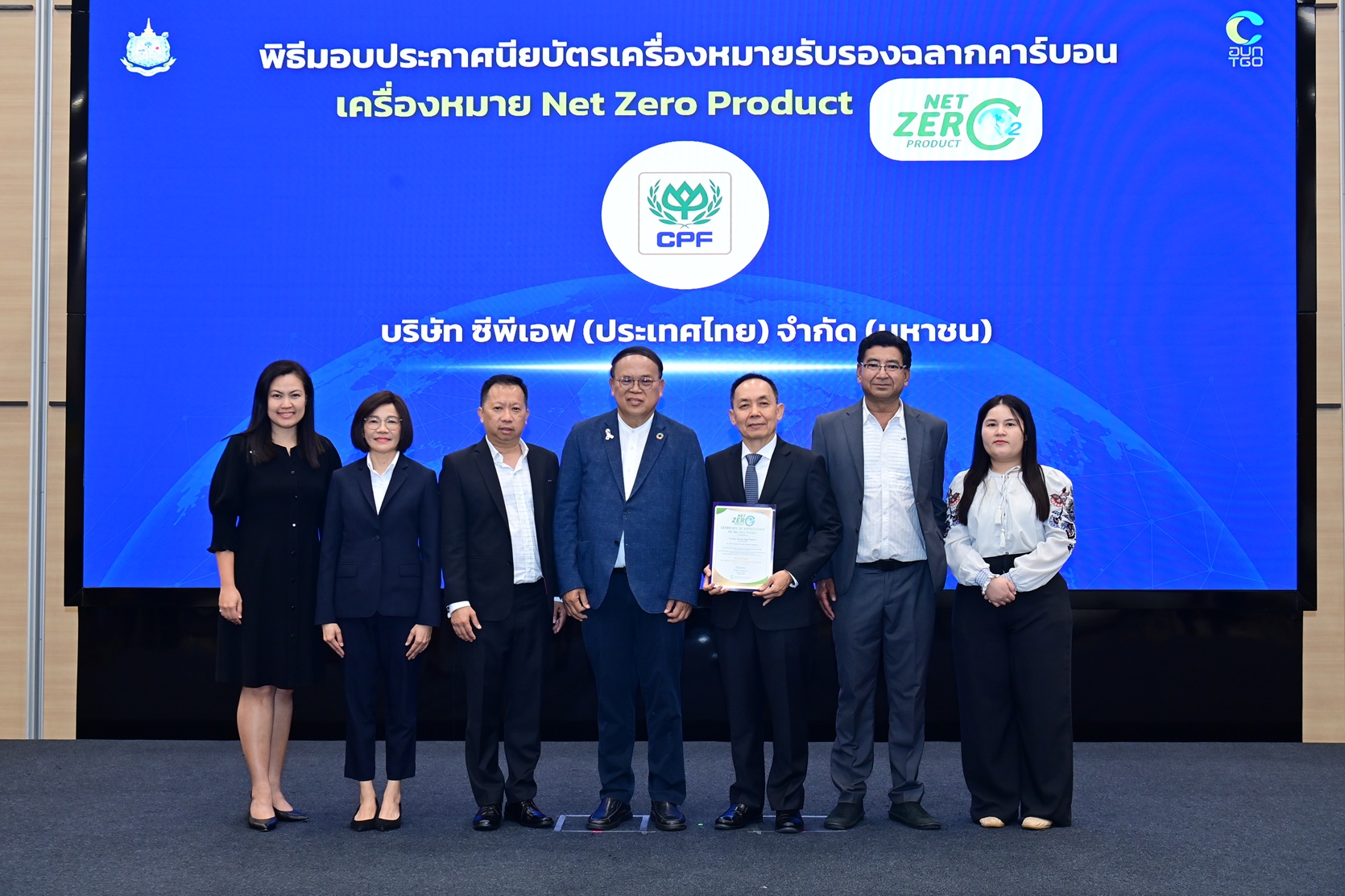

Bangkok – Charoen Pokphand Foods Public Company Limited, or CPF, continues to advance its commitment to producing food that is good for both consumers and the planet, with Benja Omega 3 Eggs under the U-Farm brand becoming the world’s first egg product to receive the Net Zero Product label from Thailand Greenhouse Gas Management Organization (TGO).
The achievement marks another milestone in CPF’s journey to become a Net Zero organization by 2050, driven by its Sustainovation approach, which combines innovation and sustainability across the food value chain. The company is accelerating the use of clean energy, improving resource efficiency, reducing waste, and developing climate-friendly products that offer better choices for today’s health- and environment-conscious consumers.
The newly certified products include Benja Omega 3 Eggs in 4-egg and 10-egg packs under the U-Farm brand. With this latest recognition, CPF now has 1,016 products certified with Carbon Footprint labels, more than 151 products certified with Carbon Reduction labels, 4 Carbon Neutral products, and 4 Net Zero Product-certified items.
Somkid Wannalukkhee, Head of CPF’s Layer Business, said Benja Omega 3 Eggs are CPF’s first egg products to achieve the Net Zero Product label. The success reflects CPF’s end-to-end sustainability practices, beginning with the careful selection of high-quality “super food” ingredients for layer feed, tailored to the nutritional needs of hens at different life stages.
This science-based nutrition approach helps hens receive the right balance of nutrients, reducing excess nutrients released as waste, such as nitrogen in chicken manure. It also supports better farm management, lowers waste generation, and contributes to the production of high-quality eggs.
CPF also applies its Green Farm model, using advanced engineering and circular economy practices to manage resources more efficiently. Solar power is used on farms to reduce reliance on external electricity, while the company adopts a Waste to Value approach by turning waste into useful resources. Damaged eggshells, for example, are repurposed as soil improvement materials, while recycled paper packaging is used to help reduce environmental impact.
After maximizing carbon reduction throughout the production process, CPF offsets the remaining unavoidable emissions with carbon credits from reforestation projects, enabling Benja Omega 3 Eggs to achieve Net Zero Product certification.
Beyond its environmental credentials, Benja Omega 3 Eggs are designed to meet the needs of modern consumers seeking nutrition, safety, and trusted sourcing. The eggs contain up to five times more omega-3 than regular eggs and are rich in DHA, vitamin E, and iodine, supporting heart, brain, and overall health.
Consumers can also be confident in the product’s responsible production. Benja Omega 3 Eggs come from high-quality laying hens raised with carefully selected feed and strong biosecurity measures. Many are raised in cage-free systems that support healthier hens, with no hormones and no antibiotics used throughout the raising process.
“The Net Zero milestone of Benja Omega 3 Eggs proves that livestock farming and environmental responsibility can move forward together,” Mr. Somkid said. “We are not looking only at business performance, but also at food security and sustainability for future generations. CPF remains committed to achieving Net Zero by 2050 and to helping create a better world through every bite consumers choose.”
The certification underscores CPF’s broader commitment to delivering high-quality, nutritious, and responsibly produced food while supporting Thailand’s transition toward a low-carbon economy and global climate goals.